B.C. Pay Transparency Is Here. Do You Know What Your Public Report Will Say?
If your business had 50 or more employees in B.C. on January 1, 2026, November 1 is a deadline you should already be preparing for. Beginning this year, B.C.'s annual Pay Transparency reporting requirement expands to employers with 50 or more employees, bringing approximately 8,500 employers into the reporting requirement. By November 1, 2026, affected employers must prepare their Pay Transparency Report, which is then made publicly available.
At first glance, this might sound like another compliance exercise. Gather the data, generate the report and get it posted by the deadline. The Province has even developed an online reporting tool to make that process easier.
The part we think employers should be paying attention to now is what happens before the report gets published. What if you run your first report in October and discover a pay gap you weren't expecting? There may be a perfectly reasonable explanation for it, or it may uncover compensation practices worth taking a closer look at. Either way, a few weeks before the deadline isn't when you want to start figuring that out.
First, make sure you know whether you need to report
The 50-employee threshold is based on your employee count on January 1, 2026, not your headcount when the November deadline arrives. The Province's guidance also confirms that B.C.-based employees are included whether they work on-site or remotely.
It is worth looking carefully at your workforce rather than simply counting your full-time permanent employees. The Province's reporting guidance specifically includes paid employees regardless of employment status, including full-time, part-time, seasonal and temporary employees.
In other words, a business that feels like it has 45 employees may discover that the actual number is 52.
Read the Province of B.C.'s Pay Transparency reporting guidance
What will your report actually show?
This is where things get more interesting. The public report doesn't list individual employees, salaries or job titles. Instead, it shows gender-based differences in areas such as hourly pay, overtime and bonus pay, along with the representation of different gender groups across four pay segments. The Regulation also includes privacy protections that suppress certain information when there are fewer than 10 employees in a gender category.
The Province has created a mock report showing what the finished product can look like.
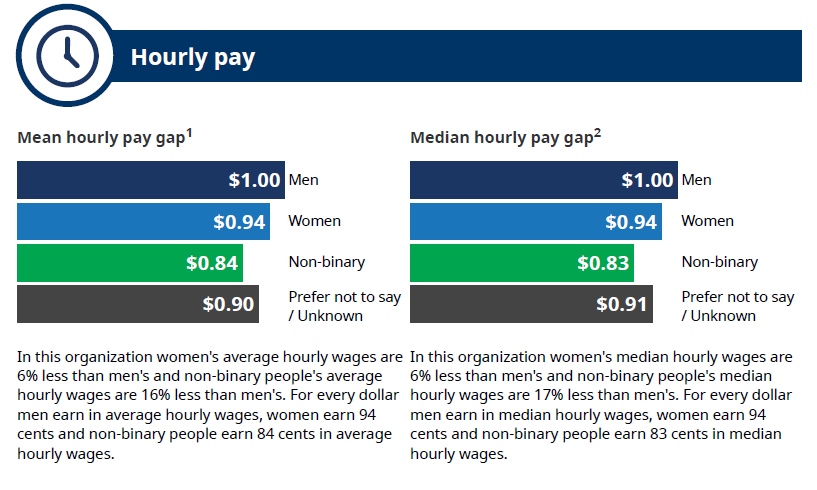
In this example, women's average hourly wages are 6% lower than men's. The report translates that into very understandable language: women earn $0.94 in average hourly wages for every $1.00 earned by men. Non-binary employees earn $0.84.
Now imagine that was your report. Would you know why the difference exists?
A pay gap doesn't necessarily mean there's a pay problem
This is an important distinction. Your Pay Transparency Report will show differences in pay between gender groups, but the report itself doesn't tell you what is driving those differences.
If your report shows a gap you weren't expecting, that's when it's worth taking a closer look. Is the difference connected to the types of roles people hold, seniority or experience? Are there inconsistencies between similar positions? Could past hiring, promotion, salary increase, bonus or overtime practices be contributing to the result?
There may be a reasonable explanation for what you're seeing, or the numbers may highlight an area of your compensation practices that deserves more attention. The important thing is to understand which it is before the report becomes public.
Don't wait until October to find out where you stand
The good news is that November 1, 2026 doesn't need to be the first time you see your results. The Province's reporting tool allows employers to upload their data and generate a draft report to review before creating the final report. If there are errors or something needs to be corrected, the data can be updated and uploaded again. B.C. Pay Transparency Reporting Tool and instructions provide further details.
We believe employers should take advantage of this. Run the report early enough that you have time to understand it. If something surprises you, dig into why. Look at comparable positions, salary ranges, starting salaries, increases, promotions, bonuses and overtime practices where appropriate.
The objective isn't to try to make the report show a particular result. It's to understand your compensation practices well enough that the report doesn't tell you something about your business that you didn't already know.
Need help getting ready?
For many businesses, 2026 will be their first year completing a Pay Transparency Report, and there are a few steps to work through before November 1, 2026.
Move HR can help determine whether the reporting requirement applies to your organization, collect the required employee gender information, prepare employee communications, organize the necessary payroll information, prepare your reporting data, and work through the reporting process with you.
We can also help interpret your draft report and understand what may be driving the results. If the numbers uncover broader compensation questions, we can dig deeper through compensation reviews, benchmarking, job alignment, and salary structures so you aren't simply reporting the numbers. You understand what's behind them.
The Province has made generating the report relatively straightforward. Understanding what it's telling you about your business is the more important part.
November 1 is the deadline. Don't wait until October to find out what your report is going to say.